Soggy Field and New Perspectives: Despite the Weather, Excavations Continue and New Methods of Investigation are Put to Task

Week Two of Memorial University's 2025 Field School on Turpin’s Island, Little St. Lawrence
“Spoiled”, as we say in NL, with the gorgeous weather of week one, Monday’s gloom brought an opportune moment to have our first lab day. In our space above the town office, we cleaned the artefacts unearthed thus far. It also provided the perfect opportunity for Dr. Losier to give us a crash course in identifying and categorizing ceramics – an essential skill given the rich deposits being discovered on Turpin’s Island. A ray of sunshine appeared in the afternoon in the person of Maria Lear, Department of Archaeology’s curator and geophysical tech specially brought to the field to implement a Ground-Penetrating Radar (GPR) survey.
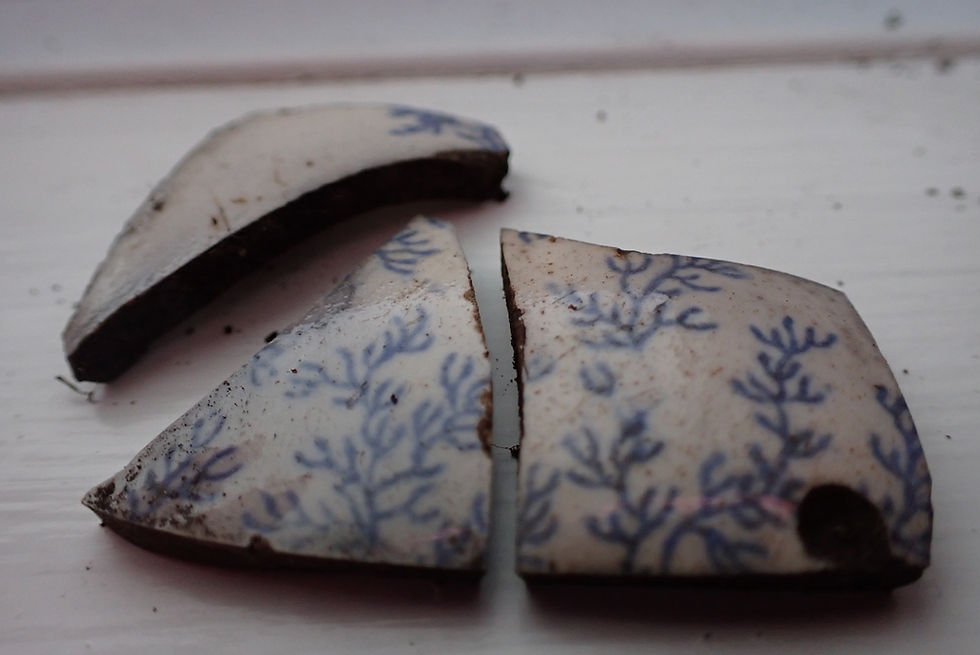
Fig. 1 Lab work; Catherine giving a ceramic lecture; ceramic sherds found on site
The weather continued to pose challenges throughout the week, but sometimes you just have to persevere and get soaked while excavating. On Tuesday, each excavation team took the time to orient the others on their test pits, their finds, their excavation objectives and interpretations.
Afterwards, Maria began the task of surveying portions of the site with the Ground-Penetrating Radar (GPR), bringing a new dimension to our research on the island. This equipment uses low-frequency sound waves to detect changes in soil density, which could indicate disturbances in the natural soil layer and the existence of human-made features (such as walls or trenches) below the surface of the soil. This data takes time to analyze, so stay tuned for new discoveries next season!
Fig. 2 Sam discussing the objectives and interpretations in Test Pit # 46; Maria surveying a grid with the GPR
Tuesday, July 1, also marked a special day for Newfoundland, and for Canada. It was of course Memorial Day for us Newfoundlanders and Labradorians – a day to remember the bravery of our own who have gone to fight in days gone by, but also a day to celebrate our great country, Canada. Thanks to the kind folks at the Little St. Lawrence Community Centre, we were able to enjoy some great food, games, and the opportunity to meet the amazing people from the community.
Fig. 3 Canada day celebrations
Luckily for us, the call for lab work was made twice this week; we kept nice and dry during the rainy days – or some of them at least, while also performing a very important part of the job, diligently cleaning every artefact (and yes, that means with a toothbrush) and completing our records and paperwork. This work is essential in preserving the artefacts for future research, public display, and in contextualizing the importance of our discoveries; it is an invaluable part of archaeology.
Fig.3 Artefact curation in the lab

Another, equally important, goal of ours is to remain connected with the community so that everyone can follow our research and learn more about the history of the Chapeau Rouge region. We have had more than a few visitors in the first two weeks, each more interested in the project than the last. So far, we have been visited by adults, kids, and dogs via walking, ATVs, kayaks and even a backhoe. Some visitors even bring us treats 😀. Visiting the site is a must in order to understand what exactly was going on here hundreds of years ago.
One objective this year is to better understand what initially appears to be a simple pile of rocks — a feature well known to community members as it prominently stands out in the landscape of Turpin’s Island. Rosalie and Raphaëlle in Test Pit #45 have identified the remains of perhaps an oven made with stones and bricks. So, this pile of rocks is much more interesting than what it looked like at first sight! More on this next week.
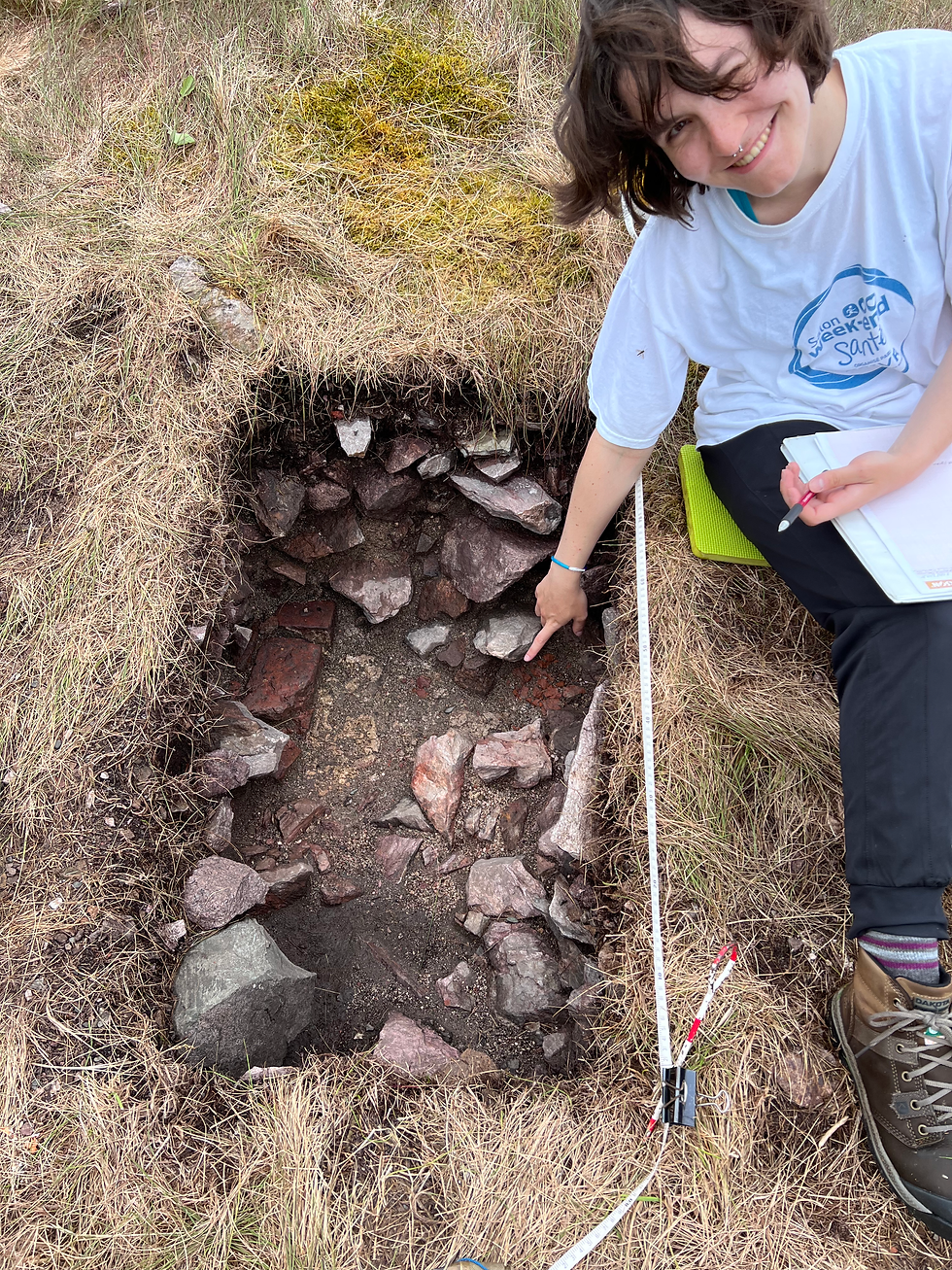
Adam and Sam continued to excavate Test Pit #46, the location of the Turpin’s homestead. The pictures of the house that we had the chance to see show many windows and this was reflected in the excavation.

Mark found a couple of fairly complete early 20th century wares, such as a saltshaker and a mason jar, in Test Pit #54. Could this feature be the remnants of a general store??? Probably not, more on that in next week blog post. This sector is super interesting. Brendan’s Test Pit #53, yielded a wide range of artefacts including a small doorknob and large hinge of unknown date and origin. In addition to these more recent artefacts, Brendan also discovered numerous 18th century artefacts that seem to be associated with the French occupation of Turpin’s Island.
Sanaa and Maya worked diligently to complete the map the wall section they had identified in Test Pit #51. This wall is massive extending on at least 20 meters. They closed their excavation by drawing the stratigraphic profile of the test pit, which is a method of illustrating the distinct layers of soil within the pit and the final phase before closing out an excavation.
Having completed their test pits, Clarke and James began plotting out and stripping a new area of sod for a much larger unit (unit 3A). This new unit will be discussed in the next blog post, but we can already disclose that the objective is to better document a feature associated with the occupation of the site by Newman & Co (1784-1811).
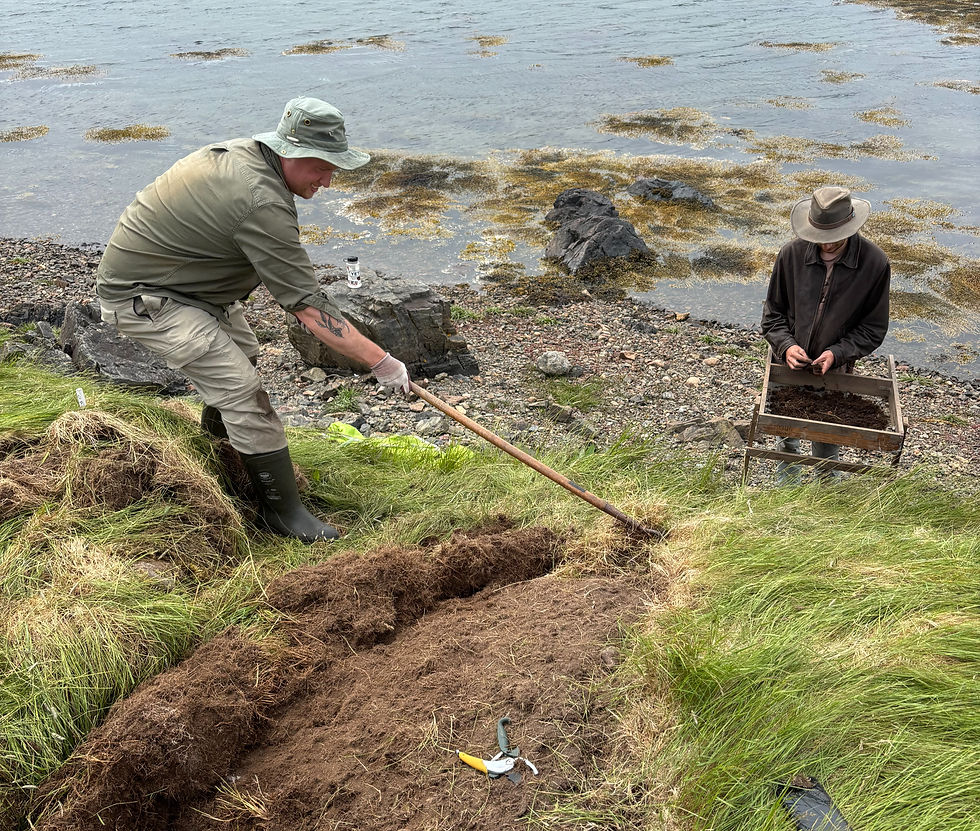
Although we try to keep a Monday to Friday, 8:30 to 4:30 schedule, we take every opportunity to learn more about Turpin’s Island and the role that it played in the vast Atlantic trade network and global geopolitics. Accordingly, we were very happy to have Neil Burgess of the Newfoundland Shipwreck Preservation Society join us on Saturday to explore the waters around Turpin’s Island. Despite the sonar surveys and diving, the harbour of Little St. Lawrence was reluctant to give up its secrets so readily. In short, not much was found, but what an amazing day on the water it was!
Fig. 7 Sonar survey and underwater exploration

Archaeology has a tendency to bring people from far and wide to work on a site, often to places they never imagined, or knew existed. While that is not entirely the case here, we do have some team members who are “Come From Aways,” and it would not be right to have them work here without feeling at home. So, to cap a hard work week in a soggy field, we decided to make these fine folks honorary Newfoundlanders. Thanks to Hubert and his crew at the Trophy Lounge, we Screeched-in eight of our own, as well as six employees from CFI Mining. It was a fantastic night for everyone and we had way too much fun singing karaoke.
Fig. 9 Screeched-in ceremony master and the new eight honorary Newfoundlanders
The interest in the project by community members has been immense, and this is greatly appreciated by each and every member of the Memorial Archaeology team. Maintaining historical ties is important throughout Newfoundland and Labrador, and we cherish every opportunity to help unlock, understand, and share this history through our research and discoveries. So, if you are reading this, come visit! We are on the island from 8:30 am until 4:30 pm, Monday to Friday. If the sign is out by the road, the site is open to all visitors, and we would love to see you there. Stay tune for next week blog post and real amazing archaeology!

Bonus 1: Drone flight over the excavations
References:
Losier, C., Ledger, P., Whitridge, P. (2024). “Turpin’s Island, Little St. Lawrence, CfAu-05. Small Scale Archaeological and Paleoenvironmental Excavation” Provincial Archaeology Office 2023, Archaeology Review, Vol. 22, p. 95-109.
Losier, C. (2025).“Turpin’s Island, Little St. Lawrence, CfAu-05. Survey and Identification of Features”. Provincial Archaeology Office 2024, Archaeology Review, Vol. 23, p.188-201.
Authors: Adam Farrell and Brendan Ryan

Comments