Artifact of the Week Series: Buckling Up for a Brass Find!

An exciting find from the third week of excavations on Turpin’s Island, we present a small brass buckle, found while sifting through a collapsed wall in Unit 3A this past week. Small and easy to miss, this little buckle jumped out at us once it made its way into the sifter. When compared to most of the other metal artifacts recovered so far on site this buckle has been very well preserved. This is due to material in which it was made; brass, which unlike iron does not oxidize quickly and can remain lightly tarnished when left out to the elements for many years.

This buckle was likely a garter buckle, due mainly to its size, but also its simple design. While boot and breeches buckles were usually larger and often decorated, as were girdle buckles, garter buckles were small and often lacked decoration because they were hidden as part of the undergarment. Garter buckles, used to attach stockings or sleeves to the wearer's legs or arms, were common garments after the Middle Ages. There are however notable peaks and troughs in popularity. In Europe the 18th century saw women begin to wear garters more frequently, and the first major resurgence in the style for men since the 14th came in the 19th century with fashion trends heading towards sleeve garters.
This leaves many possibilities for the exact date of the buckle found in Turpin’s Island, but as we have no evidence that would connect this site to the 14th century and the associated garter fad, this buckle was likely from the resurgence of sleeve buckles amongst men in the 19th century. While it is possible that this buckle came from a woman’s garb, there were far more men (and likely far more sleeve garters worn by them) than women’s stocking garters on Turpin’s Island during the 18th and 19th centuries.
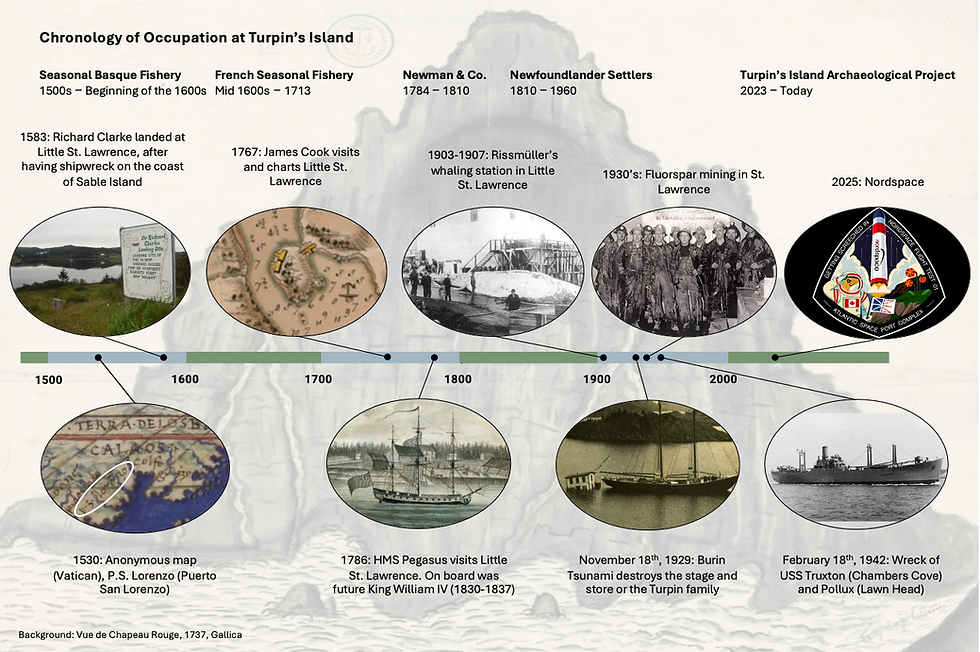
During the later 18th and into the 19th century the Turpin’s Island site was occupied by Newman & Co. a fishing company that settled on the site in 1784. This, combined with the artifact being located in a feature currently associated with the Newman & Co. occupation we can confidently say this buckle is likely from the Newman & Co. occupation and thus of English manufacture or possibly the Turpin and Thorne family occupations that began in the 1830s which would also likely mean the buckle was of English origin.
Bryant, Nancy O.
1988 Buckles and buttons: An inquiry into fastening systems used on eighteenth-century English breeches. Dress 14(1): 27–38.
White, Carolyn L.
2009 Knee, Garter, girdle, hat, stock, and spur buckles from seven sites in Portsmouth, New Hampshire. International Journal of Historical Archaeology 13(2): 239–253.
Author: Clarke Simonsen


Comments