Blue Skies and Blue Goodbyes: Digging, Backfilling and Farewells

Week Four of Memorial University's 2025 Field School on Turpin’s Island, Little St. Lawrence

As the fourth and final week of field school rolls in, things have started to speed up on Turpin’s Island. Test pits 45 and 54 still need to be completed, and the 3A and 1B excavation units have yet to be fully excavated and documented. Thankfully, the warm sunny weather allowed us to work as much as needed (although some might have called the temperature “muggy”!). Without further ado, here is our last week in a nutshell.
We started our last week with a penultimate team supper of jiggs’ dinner, cooked by James. He whipped up gravy, bread pudding, and dished up boiled vegetables. Jigs dinner, also known as Sunday dinner, is a traditional Newfoundland meal best enjoyed with family, and after these four weeks, we had become a proper little family. We packed our plates and eagerly ate to fuel up for the last week on the island.
Fig. 2 James Jiggs/Sunday dinner! Thanks a million friend!
The hot weekend weather carried into the start of the week, and as the field team quickened their pace on the field and continued excavating and drawing, and the lab group spent the day learning the ropes of cataloguing and photographing artifacts. Anna, Clarke, Kayla, Maya, and Sam cleaned and organized the artifacts according to their test pit/units and layers. An abundance of glass bottles, ceramics and nails were our main tasks for the day. Each piece, regardless of its size, is thoroughly washed and labelled. A photo was taken of each artifact according to the layer it was found in, with a scale and a title board. This work is fascinating because it lays out and reveals the connections between each piece, helping us better understand the daily life on Turpin’s Island over the last 500 years. Monday night, most of the team reunited to indulge in some of Brendan’s world-class moose chili.
Fig. 3 Lab work during week 4
On Tuesday, in the lab, we were cleaning and bagging artifacts and thinking about how things were soon to be completed. In the trenches, digging, and having fun with all our newfound friends was beginning to feel bittersweet as we knew some of us would be heading back to different universities (Memorial University and Université de Montréal) and that there was little archaeology, in the field or the lab, left to do.
In trench 1B, we continued digging and uncovering French artifacts dating from the 17th century until approximately 1713, when the French were relocated from the area by the British at the signing of the Treaty of Utrecht. Equally significant to artifacts, was the discovery of a stone feature that may represent the foundation of a building. There are three fascinating aspects to this feature:
The presence of nails and rust stains on the stones suggests we are looking at the remains of a wooden structure—the wood has decayed, but the stone foundation and metal traces remain.
Fig. 4 The stone feature in trench 1B and Valentin recording the rust stain on the stones (each of the bamboo sticks are representing rust stain)
Its association with French material culture leads us to believe it was constructed during the French occupation of Turpin’s Island (before 1713).

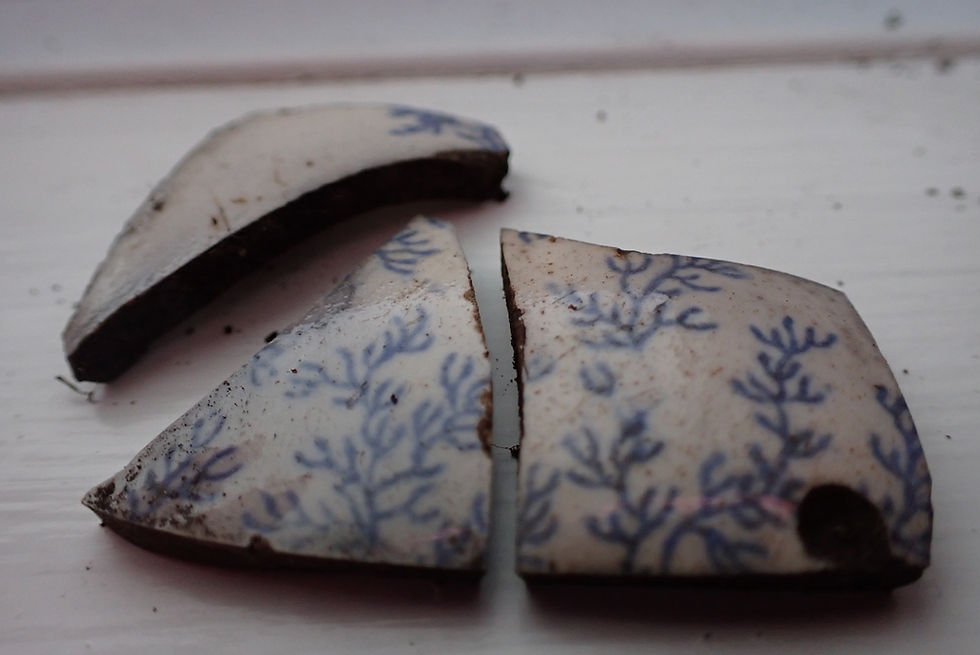
Fig. 5 French (Breton) ceramic Its relationship with Stage 1 suggesting it may represent the land-based section of the stage.
Fig. 6 Location of trench 1B in relation with the remains of a stage; French fishing station featuring a stage, in Henri-Louis Duhamel du Monceau, Traité général des pesches, Paris, Saillant et Nyon, 1769-1782
This feature is particularly interesting because it is located very close to the area where a cod bone layer was identified in Test Pit 36, excavated in 2024. As noted in last year’s blog post, French artifacts were also found in that layer, suggesting a possible connection between the occupation of the site by French fisherfolks, the stone foundation, and the cod bone deposit.
Otherwise, Rosalie and Raphaëlle, working in Test Pit 45, were also wrapping up the drawing of their excavation. The structure they uncovered is hypothesized to be an outdoor oven. More work will be done on this fascinating feature in the future! If you would like to see a 3D model of the oven, check out the Week 3 blog post.
Fig. 7 Rosalie and Raphaëlle drawing a stratigraphy in Test Pit #45
After a day in the lab and out in the field, Brendan, Clarke, Kayla, Raphaëlle, Maya, and Mark set off on a mission in search of a mysterious cannon. The story of this cannon had been told to our crew many times, and we were eager to see if it really existed, supposedly located at the southern tip of the island. The team geared up with snorkels and a kayak and set out along the island’s coast to find it. To our dismay, we found nothing. But the evening was not wasted, the time spent in the water and the laughs we shared made for a sweet and memorable adventure
On Wednesday, excavations were wrapping up quickly. In unit 3A, the team finished excavated what we believe to be a drain located near an unidentified feature and recovered many artifacts, likely associated with the Newman & Co. occupation of the island (1784-1812).
Fig. 8 Unit 3A and artefacts associated with Newman & Co.
Mark completed the excavation of Test Pit 54, along with its stratigraphy, with help from Rosalie—who was temporarily pulled from the lab for this very task. This test pit is especially interesting, as it allowed us to document a newly identified feature on the site. Back in the lab (graciously hosted by the St. Lawrence Historical Society and the Town of St. Lawrence), cataloguing and photographing of artifacts continued. Students and TAs frequently visited the excellent Lunch Tin Café for home-cooked meals (special mention to Lisa for her delicious molasses beans) while the crew in the field enjoyed what felt like their millionth ham sandwich.

On Thursday, James, Brendan, Sanaa, Val, Adam, and Clarke got to work filling in the test pits they had excavated, laying down landscaping fabric and starting a bucket train. The trenches and test pits we had painstakingly excavated over the past four weeks were filled in within just a few hours. The landscaping fabric was placed so that archaeologists in future seasons will be able to pick up exactly where we left off. Backfilling is also necessary to protect both the features and the archaeological potential of the site. Once the fill-in was complete, we carefully replaced the sod we had removed. In a few months, the signs of this year’s excavations will be barely noticeable. Preserving the natural beauty of the site is very important to the team, as we hope the island can be maintained in its current state for years to come. By the end of the day, all but the final excavation unit 3A had been filled in.
Thursday was a big and important day for us as two community engagement activities were planned. Anna, Kayla, Maya, Mark, Raphaëlle and Catherine put together a little workshop with the St. Lawrence Community Youth Network to allow local kids to connect to their hometown’s archaeological heritage. This was an amazing experience for the youth and archaeologists, and we are looking to do this again next year.
Fig. 10 Workshop with the St. Lawrence Community Youth Network
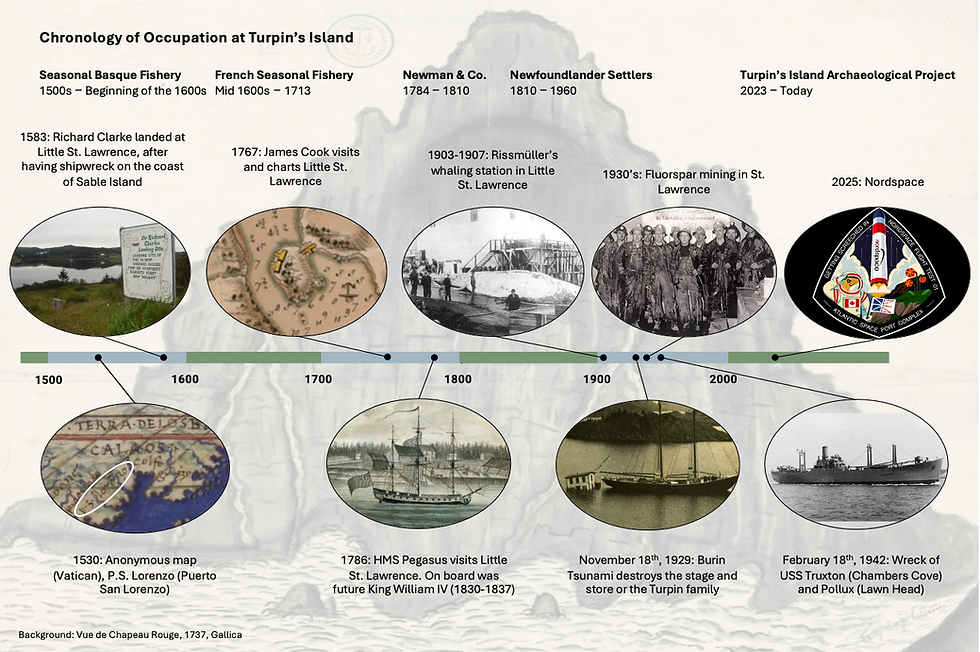
In the evening, the whole team headed to St Lawrence’s recreation center for our famous community night! Catherine gave a short conference to explain the Turpin’s Island timeline and the summer’s findings and the whole crew took the time to present some of the most interesting artefacts we found to the public. A big shout out to the community of St. Lawrence and Little St. Lawrence who came to the event (we counted 56 people attending!!!), we are beyond grateful for your interest in the project. It is super important for us to be able to connect with the people welcoming us in their community.
Fig. 11 Community night at the St. Lawrence recreation center
We ended the night at the Trophy Lounge next door, where Brendan gave his all—singing and playing the guitar, including a lovely ballad dedicated to Turpin’s Island and our teammate Sam. As everyone began to head home, we said our au revoir and à bientôt to Valentin, who, in true Terre-Neuva fashion, headed back to France the very next day.
After a week of sunshine and high temperatures, rain and fog made for a muddy backfill day. On Friday, all hands were on deck to help with backfilling unit 3A and to bring the tools from the site back to the vehicles. The work went quickly: we started at 9:00 am and finished by around 11:00 am. That marked our last time leaving the island this summer. Back at the house, everyone pitched in to clean, sort, and store our trusty tools and buckets. Kayla, Anna, and other team members focused on finalizing the artifact-bagging-boxing operation that had been ongoing for the past week. Once all the work was done, it was time to clean the houses and finish packing—or, for some, to start thinking about packing—in preparation for leaving the next day.

At night, we all reunited at the big house for a goodbye party featuring leftovers (crab and pizza, anyone?) and homemade karaoke. For most students, the goodbyes were really just “see-you-laters.” All in all, we agreed that we will surely become colleagues in the future. Luggage, backpacks, and boxes were crammed into the cars as everyone began to leave Little and Greater St. Lawrence. Catherine made sure to pass along pieces of fluorspar as souvenirs, gifted to the team by a community member ❤️. We all headed back to St. John’s, and for two of us, onto a Montreal-bound plane, to resume our studies, work, or further travels.
After (somehow) even more granola bars, fruit snacks, and other bites than last year, about a million songs sung at karaoke or in the field, an exorbitant amount of crab, and many unfortunate sunburns, the archaeological season at Turpin’s Island was officially over. We want to share a heartfelt thank you to the Little St. Lawrence and St. Lawrence community members for their involvement, to the many on-site visitors, and to everyone who made the field school possible once again. Another big thank you to our TAs—Cassy, Anna, Kayla, and Valentin—and a huge merci to Catherine, who taught us the practical side of archaeology with great care.
Thank you to the Provincial Archaeology Office, Transforming Climate Action, the Harris Center and Memorial University Faculty of Humanities and Social Sciences for making this work possible. Above all thanks a million to the community of Little St. Lawrence and St. Lawrence, it was a great to be at home again for this field work.
See you next year, Turpin’s Island!
Bonus: Map of the 2025 excavations (map by Valentin de Filippo, 2025)

References:
● Losier, C., Ledger, P., Whitridge, P. (2024). “Turpin’s Island, Little St. Lawrence, CfAu-05. Small Scale Archaeological and Paleoenvironmental Excavation” Provincial Archaeology Office 2023, Archaeology Review, Vol. 22, p. 95-109.
● Losier, C. (2025).“Turpin’s Island, Little St. Lawrence, CfAu-05. Survey and Identification of Features”. Provincial Archaeology Office 2024, Archaeology Review, Vol. 23, p.188-201.
Authors:


Comments