Artifact of the Week Series: The Beauty of Breton Ceramics!

Updated: Jun 9
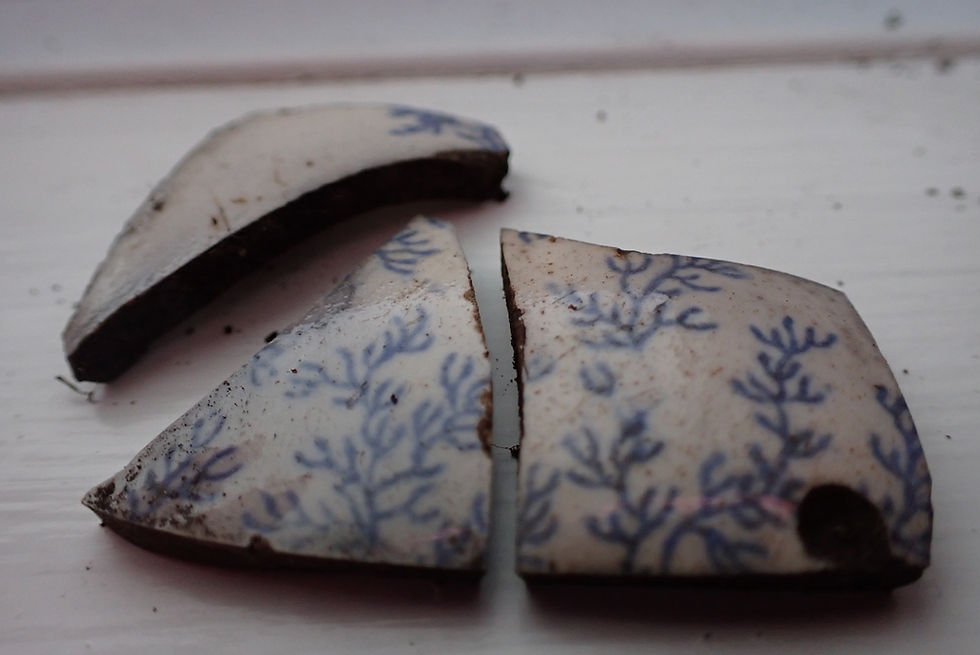
One of our notable Artifacts of the Week from Turpin’s Island is a fragment of Breton coarse earthenware, which was found in Test Pit #59 during the first week of the 2026 field school! This small fragment originates from Brittany, a region in northwestern France that was pivotal in crewing and provisioning the majority of France’s cod fishing ships between the 16th and 19th centuries. Its presence at Turpin’s Island sherd testifies to French fishing activity, specifically by crews of Breton and Norman fishers, who controlled the inshore cod fishery along the coast of the Chapeau-Rouge from the 16th to the early 18th centuries.

This sherd is made of coarse red terracotta clay with inclusions of mica, quartz, and limonite. Microscopic analysis of the sherd suggests that it was produced in Pabu-Guingamp, a commune in Northern Brittany. Breton ceramics were produced on a largely artisanal scale between the 16th and 19th centuries to meet local and regional demand, unlike mass-produced ceramics intended for widespread distribution (such as refined earthenwares). As a result, these ceramics can serve as a proxy for identifying the regional origins of fishers engaged in transatlantic fisheries. As Breton fishers are often concealed within the oversimplified label of “French fisherfolk,” despite being a culturally distinct native group of Brittany, this discovery can help us gain a more nuanced understanding of how regionally distinct fishing crews engaged with one another.

Jennifer Colbourne

References:
Pope, Peter E., Michael Batt, Michael J. Hughes, and Roger T. Taylor
2008 Post-Medieval Breton Earthenwares in Newfoundland. Post-Medieval Archaeology 42(1):48–74. https://doi.org/10.1179/174581308X354065, accessed May 31, 2026.
Low, Kayla
2026 Ceramics of the Fisheries: An Analysis of Breton Coarse Earthenwares in the North Atlantic from the 16th to the 19th Centuries. Electronic document,
https://doi.org/10.48336/323, accessed May 31, 2026.

Comments