So Long, Little and Great St. Lawrence: MUN Archaeology Wraps up Another Successful Field Season

Week Four of Memorial University's 2026 Field School on Turpin’s Island, Little St. Lawrence
Just before the summer equinox, Memorial University’s archaeology field school sadly departs the Burin Peninsula. This fourth and final week brought last-minute finds, a community engagement night, and a memorable Friday farewell.

As we settle back into life away from sunny Turpin’s Island and the generously provided lab space courtesy of the town of St. Lawrence, we reflect on our month of fieldwork: our final week of excavation and backfilling, what we havve learned and taken from the experience, and what it means for future archaeological work in the region.

This past week, our team split up to tackle the final excavations and laboratory work. In the field, Jennifer Colbourne and Kristin Cooper wrapped up test pit 63 with the excellent find of a remarkably intact glass bottle base dating o the Newman & Co. occupation of the island. Test Pit 63 is quite difficult to understand, it looks like a 20th century feature, perhaps the barn of the Turpin family, was constructed above a Newman & Co. feature. At the moment, the hypothesis about this Newman & Co. feature is that it could be a well, filled with sand at the end of its useful life and on which a more recent feature will have been built. Along the island’s eastern shore, Jason Kean and Taylor Ford undertook the final excavations of Unit 3A, which exposed a large drainage outlet onto the rocky beach.
On the east side of the island, Matt Williams and Cole O’Brien excavated the marshy Test Pit 64 in search of evidence for a small building marked on the 1786 drawing of Turpin’s Island. They have found evidence of a man-made stone foundation. This is one of the more intriguing avenues for next season, which will be to further investigate the possible location of what we believe to be a forge.. Although the test pit identified what appears to be part of the structure, no diagnostic artefacts were recovered to date it with certainty. From the beach, however, both slag and slate were found, and nearby stones appear to form a wall leading up toward the test pit, suggesting that this area eroded quite dramatically since Newman & Co. occupied Turpin’s Island.

Fig. 4 Zone where we have found evidence linking the feature found in Test Pit 64 to a blacksmith was found. The diverse pictures show evidence of a wall and sample of slag found eroding from the shore.

On the very last few days of field work, Kayla Low and William Squires open one last test pit for the season. Test Pit 65 was located in an area where the presence of a building was suspected. Anthropic modification of the natural stratigraphy was observed and artefacts dating from the occupation of the site by perhaps Newman & Co. or even French fishing crews was found. This is very interesting and the analysis of the artefacts will be important to better understand this sector of the site.
At our lab, the space generously provided by the staff of St. Lawrence Town Hall, Kayla Low led the cleaning, photographing, and organisation of the artefacts found during field work, with support from Liam Bowes, William Chafe, William Squires, and Emma Turner. This work was done over the last week of field school.
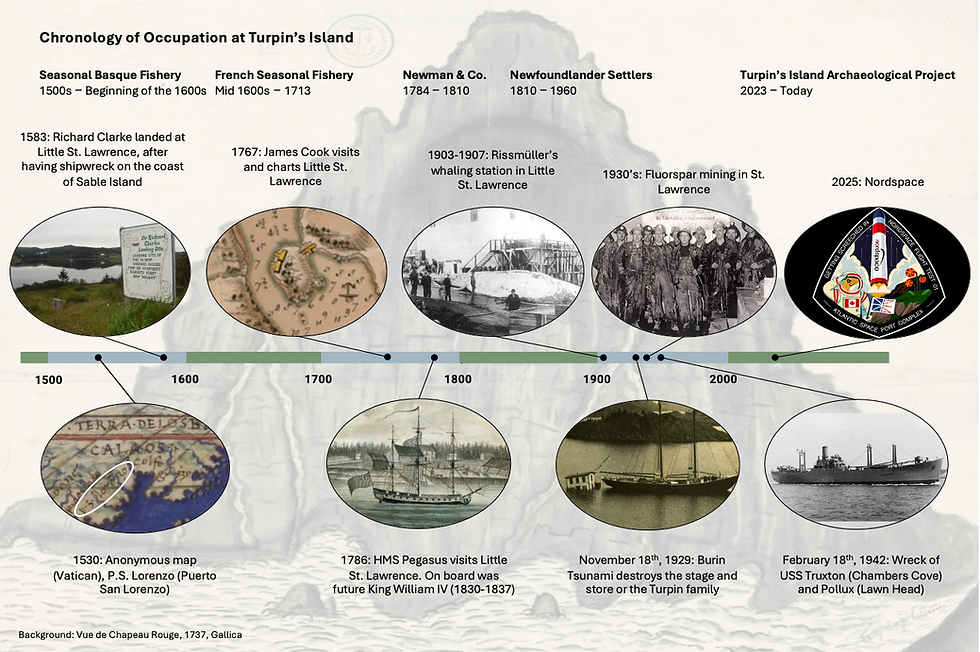
The highlight of our final week in St. Lawrence was the community night held at the St. Lawrence recreation center on Thursday June 18th, 2026. Events like this create a vital connection between the archaeological team and the community, but also between people and their own history. From an engaging presentation summarizing what we have learned so far on Turpin’s Island to a hands-on opportunity to explore a curated selection of this year’s artefacts demonstrating the occupation of the site over the last 500 years, the evening offered a meaningful bridge between past and present and proved to be an invaluable part of the archaeological experience.
Fig. 6 Community night at the St. Lawrence recreation center
The final two days of field work put our team under pressure as time ran short to complete drawings and notes, clean artefacts, and undertake the all-hands-on-deck backfilling process. Backfilling—returning our large piles of excavated soil and heavy sheets of sod to their original positions—was finished in these last two days. On Thursday, Liam Bowes and Matt Williams traversed the island, photographing, backfilling, and then re-photographing test pits 55 through 64. Friday, however, called for a full team effort to backfill the large amount of soil removed from Feature 3A, followed by the less demanding work at test pit 65, the final excavation of this third year on Turpin’s Island. Although the morning brought some decidedly unpleasant weather, morale was lifted by the sounds of Daft Punk’s Alive 2007.
Fig. 7 Finishing drawings and backfilling
The final aspects of the field season were completed later that afternoon at our St. Lawrence accommodations, where the team scrubbed down mud-covered shovels and buckets and photographed the last handful of artefacts. With our well-worn field gear set aside, we brought a close to a demanding and high-paced week with a lively evening at the house, enjoying a proper kitchen party as our final celebration before departing the next morning.
Fig.8 Family dinner on the last night in St. Lawrence!
Following the completion of the 2026 field school, we are proud to reflect on all that we accomplished over the past month. This year’s group carried out an impressive amount of work, opening 11 new test pits across the site, identifying 10 new features and completing Unit 3A. While many students looked forward to returning to their families in St. John’s and surrounding areas, we also found ourselves leaving behind the close-knit community we formed together in St. Lawrence, and all of our new friends.
One particularly memorable presence at the site was a visitor named Slippers (a seal), who frequently stopped by during our work and unfailingly managed to steal the spotlight. Slippers was not our only visitor in the field. We were delighted to welcome many people and animals who stopped by interested by our work, including a pair of friendly Americans travelling the world by sailboat. Another visit came from a local woman out for a walk with her teacup-sized dog, Cove, who was eager to meet everyone on site and happily explored the area while we worked (edit from Cat: Actually, no one was working while Cove was on site, despite being tiny, Cove is able to shot down any work!!! 🙂). We also need to mention Leo who is our most loyal visitor! Always a pleasure to see you on site Leo and chat for a bit! We also wish to thank Cindy and Bill from the WJ Clarke Gallery Cafe, whose outstanding coffee, treats, stories, and support from across the harbour meant so much to us.
Fig. 9 Our most famous visitors:Slippers, Cove and Leo!
On our final day in the field (after backfilling in the rain), we stopped by the Lunch Tin Café for a homemade meal before packing up for the trip back into town. During our visit, a glass table suddenly shattered right in front of us, leaving everyone momentarily stunned—though, thankfully, the staff remarked that they had never seen anything like it before. Once again, the team worked together to clean up the shattered glass and restore the café to its original state.
While not every day went as smoothly as others, that is to be expected with the unpredictability of mother nature and the work on archaeological site, but every day we were doing what we love. As we began to wrap up, we think about what was accomplished and looking ahead with excitement to what future seasons—and the next group of archaeologists—will continue to uncover and achieve at this exceptional site. Turpin’s Island, as vast as it is, still holds so much beneath its many layers of soil waiting to be uncovered. As Catherine often notes, this project could continue for her graduate students’ graduate students! Turpin's Island is simply a remarkable a site, enriched further by the strong community that surrounds it.


We extend our sincere thanks to all those in the community who made our time away from home so memorable. We are especially grateful to Paul in St. Lawrence, and to Cecilia and Guy in Lawn, for providing us with a place to stay. Actually, Turpin's Island Archaeological Project has special link with Cecilia and Guy as they are the ant and oncle of our own Cassy Drake which participate to the excavation for three years and wrote our MA thesis about Turpin's Island. A special thanks to you!
Thank you to everyone at the town of St. Lawrence, the Historical Advisory Committee, and of course the whole community of Little St. Lawrence. Our appreciation goes as well to the Newfoundland and Labrador Provincial Archaeology Office, the Ocean Frontier Institute, the Memorial University Faculty of Humanities and Social Sciences, and everyone else who made this incredible experience possible. We want to acknowledge the donation by the St. Lawrence Historical Advisory Committee in support for the Field School on Turpin's Island.
Our time on Turpin’s Island may be over for now, but the memories we made will stay with us. We began this incredible journey with rain galore on our first day on site and ended it much the same on our last, yet that never stopped us from having the time of our lives. These are memories that will last a lifetime—meals we will never forget, experiences that will remain with us, and friendships that will stay in our hearts long after we have left.


Thank you everyone, can’t wait to see you all and do it all over again next year!

Bonus 1: Map of the site at the end of the excavations, 2026

Bonus 2: Read the fantastic blog of our friend Cindy about Turpin's Island history and archaeology
References:
● Drake K.L. (2026). « An investigation of human activity and environmental change at Turpin’s Island through palaeoenvironmental and historical archives », MA thesis, Memorial University
● Losier, C., Ledger, P., Whitridge, P. (2024). “Turpin’s Island, Little St. Lawrence, CfAu-05. Small Scale Archaeological and Paleoenvironmental Excavation” Provincial Archaeology Office 2023, Archaeology Review, Vol. 22, p. 95-109.
● Losier, C. (2025).“Turpin’s Island, Little St. Lawrence, CfAu-05. Survey and Identification of Features”. Provincial Archaeology Office 2024, Archaeology Review, Vol. 23, p.188-201.
● Losier, C., Drake, K., Burgess, N. (2026) “Turpin’s Island, Little St. Lawrence, CfAu-05. Scaling Up Data Collection. Memorial University Field school 2025”. Provincial Archaeology Office 2025, Archaeology Review, Vol. 24, p.39-54.
Authors:



Comments