Artifact of the Week Series: Normandy Stoneware Found, Already Kiln It!!

Updated: Jun 9
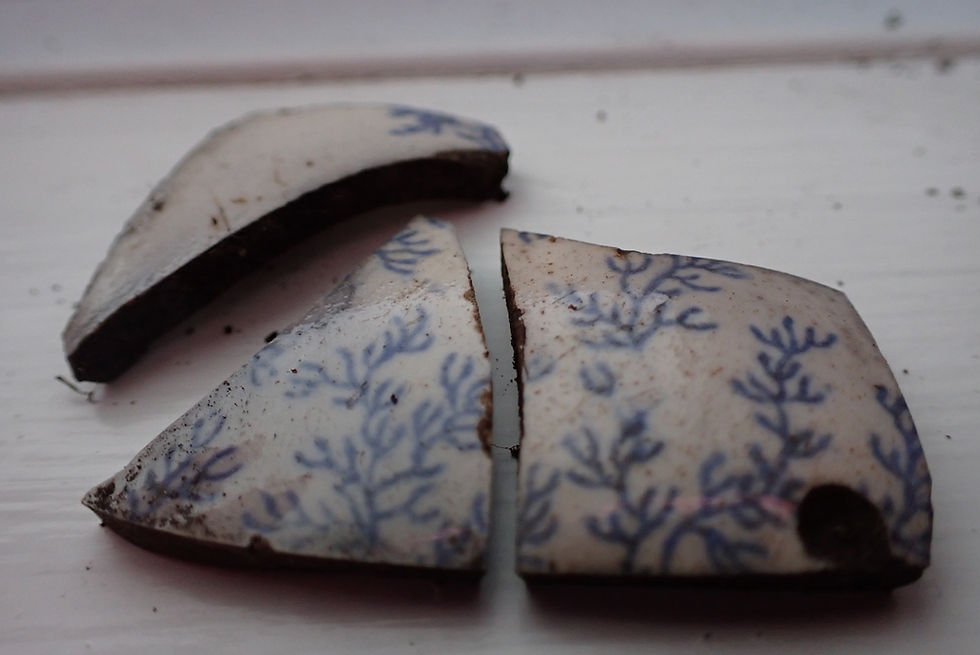
As week one comes to a close for the 2026 season for Turpin’s Island, findings have brought much excitement to the team. Today’s artefact of the week comes in the form of Normandy coarse stoneware (Fig. 1) found on just the second day of excavation! Ceramics and stoneware are common on the site, and Grès Normand (Normandy Stoneware), a type of stoneware originating from Lower Normandy, France. This is not the first example of Normandy Stoneware to be found on Turpin’s Island, as similar pieces were found by Memorial students in 2024 (link here).

Normandy stoneware is typically undecorated and wheel-thrown. Firing this type of stoneware is typically done in a horizontal longitudinal kiln at high temperatures between 1100°C and 1300°C, which creates a highly vitrified, non-porous and waterproof container. The use of these stoneware vessels was widely used in the North Atlantic, particularly for the transportation of perishable goods such as salted meat or butter, and due to their useful design, the vessels were often repurposed for storage after transportation completed. The designs of these vessels include closed jugs, pitchers, vases, bottles, ointment pots, and gourds, while open vessels include bowls, fountains, and colanders. This specific type of vessel is of Mortainais and Domfrontais origin, a southwestern region in Lower Normandy. Some of the earliest French stoneware production sites are located in this region, possibly as early as the 13th century! In the 16th century this region would be pivotal to Northern French stoneware production, primarily in Ger, however other notable workshops include Le Molay, the Bessin, and Noron-la-Poterie.

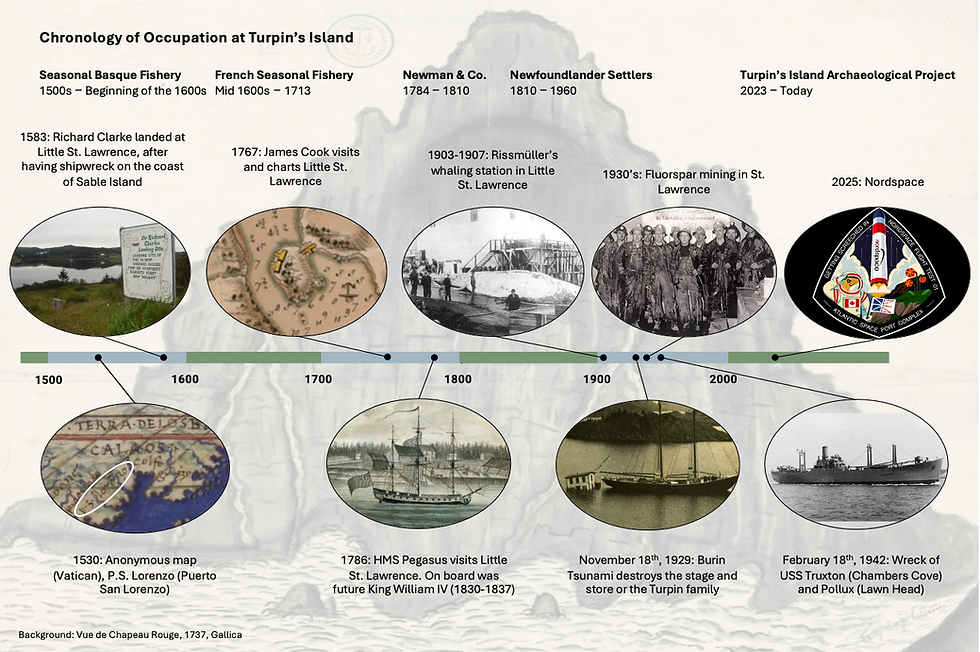
While excavating Test Pit 56, which currently sinks over 80cm in depth (Fig. 3), two pieces of Normandy coarse stoneware were uncovered, with one piece at over 7cm in length (Fig. 4)! The dating of these pieces likely lies within a range from the 17th to the early 18th century, as there is evidence of French fishing crews occupying the harbours of Great and Little St. Lawrence throughout the 1600s, up until the signing of the treaty of Utrecht in 1713! So far, this test pit has provided a plethora of interesting artifacts, with no signs of the students getting stuck between a rock and a hard place.
Fig. 3 Test Pit 56 ; Fig. 4 Close up of a rim sherd of Normandy stoneware from Test Pit 56
Matthew Williams

References:
Labonté-Leclerc, Melissa, and Delphine Léouffre
2016 Le grès. In, Identifier la céramique au Québec, edited by Laetitia Métreau, pp.
259-262. Special edition, Les Cahiers d’archéologie du CELAT 41 (Série
Archéométrie 8).
Low, Kayla
2026 Ceramics of the Fisheries: An Analysis of Breton Coarse Earthenwares in the North
Atlantic from the 16th to the 19th Centuries. Master’s Thesis, Department of Archaeology, Memorial University of Newfoundland, St. John’s.

Comments